The hum of servers in a dimly lit courtroom is a far cry from the chemical vats described in the patent.
In Enviro Tech Chemical Services, Inc. v. Safe Foods Corp., the Federal Circuit did something rather straightforward: it affirmed a lower court’s judgment. The damage, however, is anything but small. Most claims of U.S. Patent No. 10,912,321 have been tossed out, not because the underlying invention (treating poultry carcasses with peracetic acid to boost weight – yes, you read that right) was unsound, but because its description was, to put it mildly, imprecise.
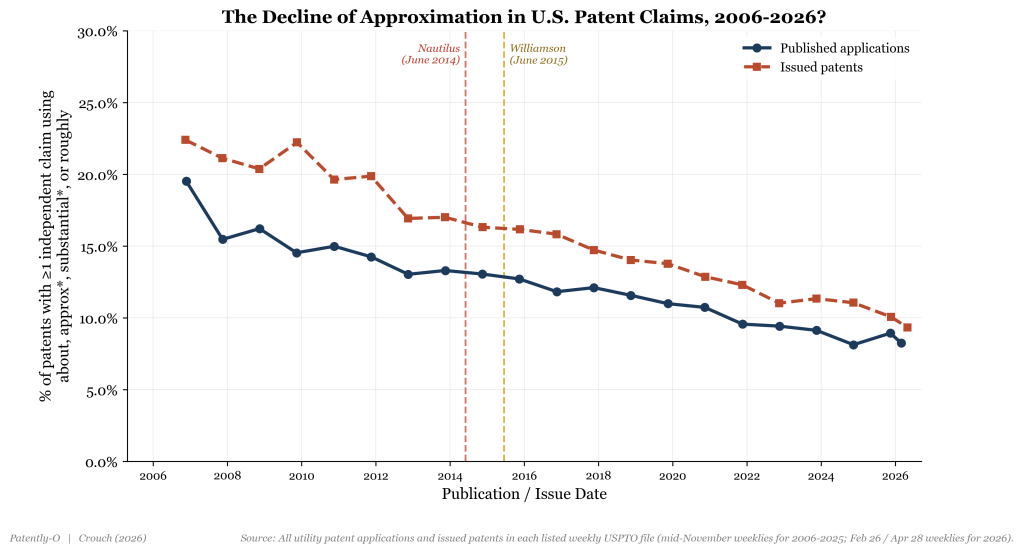
The offending language? Claims that required adjusting an antimicrobial solution to a “pH of about 7.6 to about 10 by adding an alkaline source.” Judge Lourie, penning the opinion, zeroed in on the word “about.” Apparently, even for someone skilled in the art, “about” failed to provide the necessary certainty regarding permissible deviations from the specified pH endpoints. This single word, or rather, the lack of clarity it represented, invalidated all the claims that Enviro Tech brought to court.
The court didn’t even need to address the patentee’s secondary problem: the alleged indefiniteness of “an antimicrobial amount.” A bit of a relief for Enviro Tech, I’m sure, considering their primary hurdle was already insurmountable.
When Too Much Information Becomes a Liability
Here’s where it gets interesting – and frankly, a little embarrassing for the patent holder. The specification, the very document meant to define the invention, actually contained internal contradictions. It described experiments allowing for a 0.3 pH deviation. Then, it detailed a commercial-scale trial where deviations of 0.35 to 0.5 were apparently acceptable. Instead of providing clarity, these conflicting data points muddied the waters even further. It’s a classic case of oversharing gone wrong; the specification provided too many potentially conflicting definitions of “about,” rendering the term completely meaningless.
And it gets worse. During prosecution, Enviro Tech amended the lower endpoint from “about 7.3” to “about 7.6” specifically to get around prior art hovering around pH 7.0. But they never bothered to define what “about” meant in this new context. The court’s take? Such amendments, particularly when made to narrowly dodge existing technology, demand significantly more precision. Vague terms like “about” simply won’t cut it when you’re that close to the line.
The prior art is almost ‘about’ a pH of 7.6.
That closing remark is, I’d wager, the kind of line that will be quoted in patent law classes for years. It perfectly encapsulates the issue: the patent language was so imprecise, so close to the prior art without defining its boundaries, that it effectively claimed almost nothing concrete.
The High Cost of Vagueness
This ruling isn’t just about a faulty patent on poultry treatment. It’s a stark reminder for any entity seeking patent protection, especially in highly technical fields where precise measurements are paramount. In the race to secure patent rights, particularly when navigating the choppy waters of prior art, the temptation to use broad or flexible language can be strong. But as Enviro Tech discovered, “about” isn’t a free pass. It’s a linguistic cul-de-sac that leads directly to invalidity. The market dynamics here are clear: the cost of obtaining a patent is substantial, and the cost of defending one, only to have it invalidated by imprecise language, is astronomical. For legal tech companies building AI-driven patent analysis tools, this case offers a clear illustration of the critical need for systems that can flag not just obvious issues, but subtle linguistic ambiguities that can sink an otherwise potentially valuable patent.
This decision underscores a fundamental principle: clarity is not a suggestion; it’s a requirement. When you’re claiming a specific technical range, especially one that seems to push the boundaries of existing knowledge, you’d better be able to tell a person of ordinary skill in the art exactly what you mean. Anything less, and your patent might just be… well, about to be invalidated.