The USPTO examiner, hunched over his monitor, sighs. Another design patent application. Back in the day, this was almost a formality. A quick check, a rubber stamp, and boom. Issued patent. Easy money.
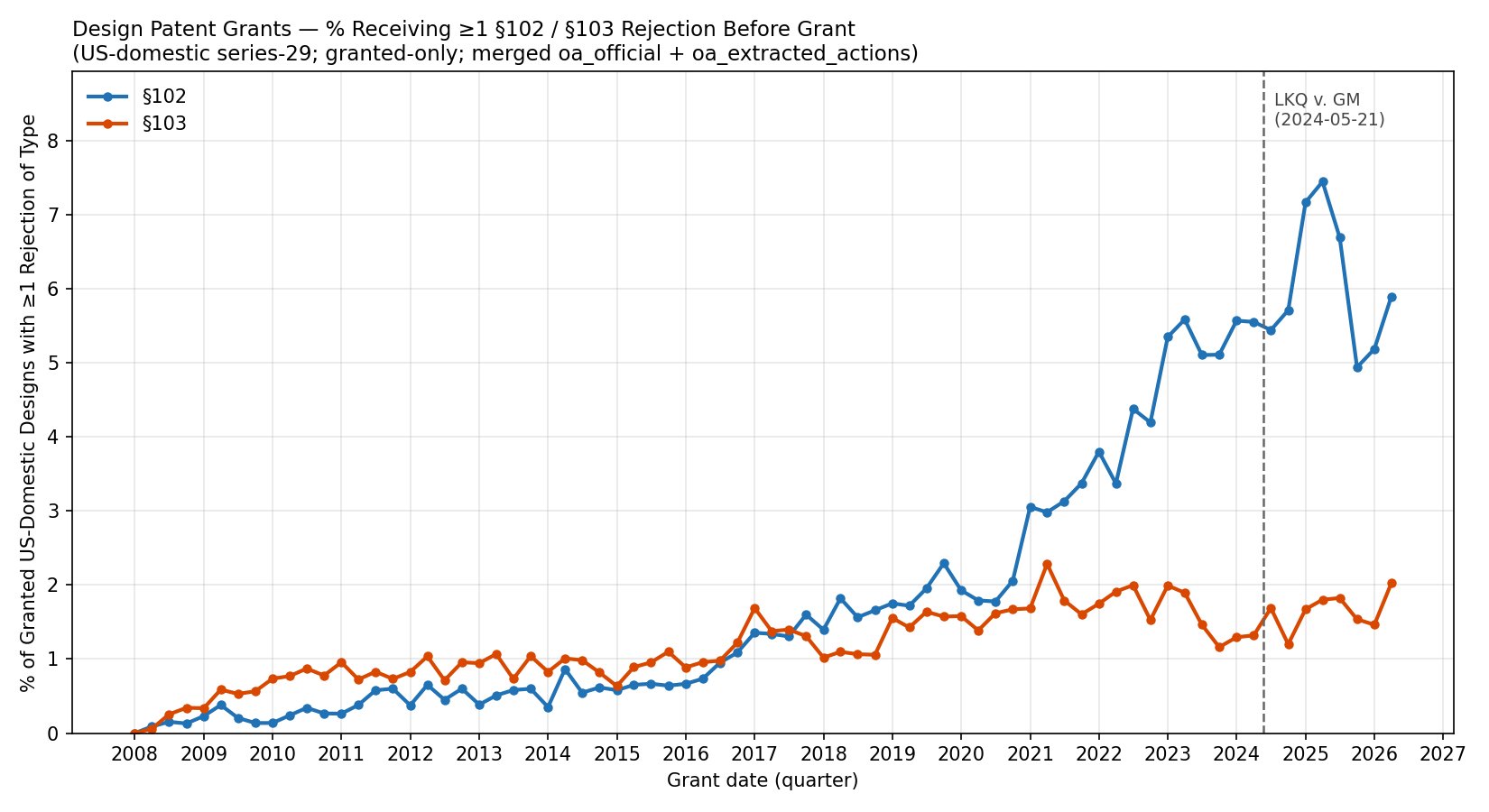
Now? Different story. The numbers don’t lie. Remember 2008? About 0.1% of design patents got hit with a §102 rejection. Cute, right? Fast forward to early 2025, and that figure shot past 7%. Even with a slight pullback to 5-6% under Director Squires, it’s still the highest it’s ever been. For folks who cut their teeth in design prosecution when prior art rejections were rarer than a honest politician, this is a seismic shift. A whole new ballgame.
What’s driving this? It’s not necessarily a newfound diligence in identifying obviousness. Those numbers for Hague System patents (the international crowd) haven’t seen the same post-LKQ bump. No, the real culprit for the surge in anticipation rejections, the ones that say ‘yep, this was already out there,’ seems to be the domestics. And the prime suspect? Amazon.com.
The hypothesis is simple, and frankly, it makes a terrifying kind of sense. U.S. applicants, the ones filing from right here, are far more likely to have their products already listed on Amazon. Pre-launch, during launch, whatever. Examiners, bless their diligent hearts, are apparently trawling these massive online marketplaces. They find the product. Bingo. Prior art. Rejection.
Foreign applicants? Not so much. Their goods might not have hit the U.S. market yet. Or they might be distributed through, I don’t know, Alibaba. Platforms that, apparently, aren’t on the typical examiner’s radar. So, what we’re seeing is a potentially more rigorous examination for U.S. inventors than for their international counterparts. That doesn’t sit right, does it?
It’s almost comical. Companies that built their empires on aggressive — some might say ruthless — marketplace tactics are now, inadvertently or not, dictating patentability for nascent designs. Amazon, the behemoth of consumer goods, has become the de facto gatekeeper of design patent novelty. This isn’t just about a few more rejections; it’s a fundamental reshaping of the examination process, driven by the realities of the modern e-commerce landscape. We’re talking about the very definition of ‘prior art’ being warped by the endless scroll of an online catalog. It’s a story as old as time: big tech finds a loophole, and the little guy has to adapt or get crushed.
So, the next time you’re contemplating a design patent, and you’ve got a presence on Amazon, maybe do a little extra digging. And then some more. Because that seemingly innocuous product listing? It might just be the reason your patent application ends up in the reject pile.
Is Amazon the New Prior Art Goldmine?
Pretty much. The data suggests examiners are increasingly using U.S. marketplace platforms, with Amazon.com being a major source, to find existing products that count as prior art against design patent applications. This is particularly impacting domestic applicants whose products are likely to appear on these sites sooner and more frequently.
Why Are Design Patents Seeing More Rejections?
The rise in rejections is attributed to improved search capabilities by examiners, specifically their use of U.S. online marketplaces like Amazon. These platforms readily reveal products that have been available to the U.S. consumer market, thereby serving as prior art that anticipates new design patent claims. This contrasts with previous eras where such broad searches were less common or feasible.
For practitioners who learned design prosecution in an era when prior art rejections were a relative rarity, that shift represents a fundamentally different examination environment.
This quote perfectly encapsulates the seismic shift. What was once a minor hurdle is now a significant challenge. It demands a more proactive and thorough approach to searching for and documenting novelty. The old ways just won’t cut it anymore. It’s like showing up to a knife fight with a butter knife.
The Takeaway: File Early, Search Thoroughly
If you’re an inventor or a legal team dealing with design patents, this is a clear signal. The bar for novelty has been raised, not by a change in the law, but by a change in how the law is applied in practice. Your pre-filing searches need to be more exhaustive than ever. Think beyond traditional patent databases. Consider every public display of your design, especially online. The time to file is now, before someone else’s similar product pops up on Amazon and makes your design unpatentable.