Patent challenges have shifted.
For over a decade, the Inter Partes Review (IPR) process has been the undisputed heavyweight champion for dissecting and challenging issued U.S. patent claims. It was the standard, the predictable path for patent challengers. But the landscape, it seems, has a seismic fault line running through it. Recent data, stretching into May 2026, paints a starkly different picture, one where the once-dominant IPR has seen its position utterly collapse.
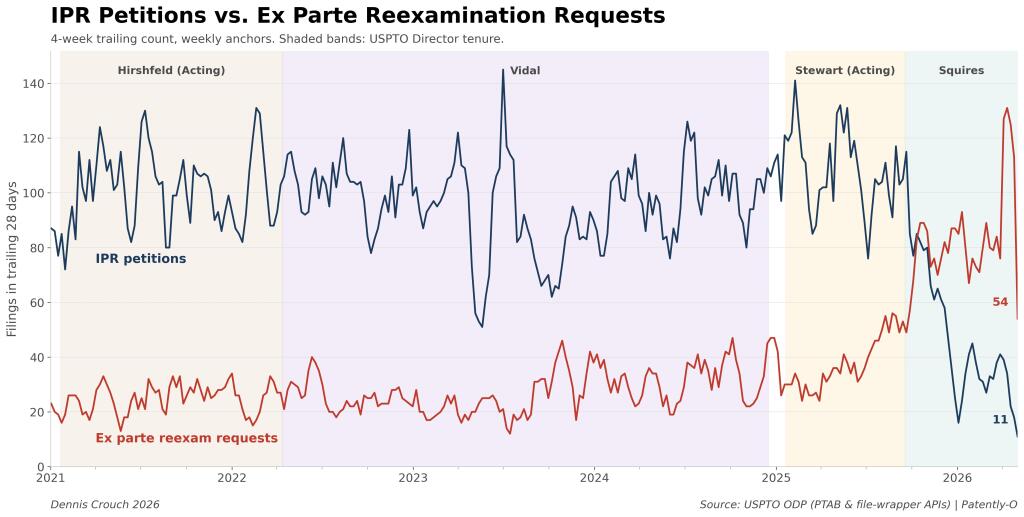
The numbers are jarring. In the last four weeks alone, we’ve witnessed a mere eleven (11) IPR petition filings – the lowest four-week tally since the system first flickered to life back in September 2012. This isn’t a minor dip; it’s a freefall. Meanwhile, requests for Ex Parte Reexamination, a process long considered a quieter, more niche option, have climbed with astonishing speed. For the first time in history, this once-marginalized procedure has officially eclipsed the IPR, emerging as the leading tool for post-grant patent validity challenges, at least at the initial petition filing stage.
The Crossover Event: A Visual Breakdown
Imagine a graph. For years, the lines traced predictable paths. From early 2021 through mid-2025, IPR petitions hummed along steadily, oscillating within a comfortable band of roughly 80 to 130 filings every 28 days. Ex parte reexamination requests, by contrast, sat demurely in the 20 to 40 range, a significant portion of which were even initiated by the patent holders themselves. Then, starting in the fall of 2025, everything changed. The lines don’t just converge; they collide with force. IPR petitions plummet, hitting a single-digit floor, while reexamination requests explode upward, recently peaking at over 130. The real kicker? The shading on the chart, indicating director tenures, shows a steady decline under Acting Director John Squires, followed by a dramatic, outright free-fall during Director John Squires’ tenure, a trend that has persisted right up to the present day.
This dramatic turnaround isn’t accidental. It speaks to a fundamental shift in how patent validity is being contested, a shift driven by perceived advantages and perhaps, disillusionment with the established IPR process. Is this an architectural change in patent litigation, or just a temporary fluctuation driven by administrative leadership? My money is on the former.
Why the Sudden Exodus from IPR?
What’s driving this exodus from the familiar grounds of IPR? While the original data doesn’t explicitly detail the ‘why’, one can infer significant shifts in the perceived cost-effectiveness and strategic utility of each process. IPRs, while offering a more structured and often faster path to invalidation, can be notoriously expensive and complex, often drawing parallel litigation in district courts. The cost-benefit analysis for challengers may have recently tipped heavily in favor of Ex Parte Reexamination, which, while typically initiated by the patent owner, can now be requested by third parties, opening up new avenues for adversarial challenges.
The structural simplicity of Ex Parte Reexamination, where a single examiner reviews patent claims based on prior art submitted by a third party, might offer a less burdensome, albeit potentially less definitive, route to invalidation. It’s less about a judicial-style contest and more about an administrative audit. This difference in procedural architecture—one akin to a trial, the other more like an audit—is critical. For challengers seeking to invalidate patents without the full drag of federal litigation, the appeal of the ‘audit’ approach is clear, especially if recent changes have made it more accessible or effective for third-party petitioners.
This shift is particularly interesting when you consider the broader trend of AI adoption in legal services. Tools that can rapidly identify prior art and structure reexamination requests could be accelerating this trend. If AI can make the initial stages of Ex Parte Reexamination more efficient and affordable, it provides a powerful incentive for its use.
A New Era for Patent Challenges?
The implications of this transition are profound for patent prosecution, litigation strategy, and the broader intellectual property ecosystem. For patent attorneys and their clients, understanding the nuances and strategic advantages of Ex Parte Reexamination is no longer optional; it’s imperative. It suggests a potential decentralization of patent challenges away from the centralized PTAB proceedings and back towards a more examiner-centric review process, albeit one now influenced by third-party challengers.
We’re witnessing an evolving battleground. The legal tech community should be paying close attention. The tools that excel at identifying prior art, analyzing patent landscapes, and generating petition-quality arguments will likely see a surge in demand. This isn’t just about a new flavor of the month; it’s a potential re-architecture of how patents are defended and attacked in the post-grant phase. The legal AI industry, often focused on discovery and contract review, needs to look more closely at the specific demands of IP litigation support. The days of assuming IPRs are the only game in town are over.
The past four weeks, we have only seen eleven (11) IPR petition filings – the lowest 4-week period since the system began in September 2012. Ex parte reexamination requests have climbed substantially and for the first time the once-marginalized process has overtaken IPR as the leading post-grant validity tool (at least at the initial petition stage).
This quote perfectly encapsulates the dramatic statistical reversal. It’s a data point that speaks volumes about the changing tides in patent law.
🧬 Related Insights
- Read more: Biglaw’s AI Nightmare: Fake Cases, Real Disasters
- Read more: Lawyers: Don’t Hire a Coach Until You Pass This Brutal Self-Test
Frequently Asked Questions
What does Ex Parte Reexamination involve? Ex Parte Reexamination is a process where a third party can request the USPTO to re-examine an issued patent. A single examiner reviews prior art submitted by the requester to determine if it shows a substantial new question of patentability. It’s typically a more focused and less adversarial process than an IPR.
Will this mean more patent invalidations? It’s too early to say definitively. While Ex Parte Reexamination can lead to patent claim amendments or invalidations, the outcomes can be less decisive than an IPR, which has formal estoppel provisions. The increased filing could, however, lead to a higher overall number of invalidated claims over time.
Is this a permanent shift away from IPRs? Predicting permanence in patent law is risky. However, the data suggests a significant strategic re-evaluation by patent challengers. Factors like cost, effectiveness, and changes in USPTO procedures or personnel under different administrations will likely influence whether this trend continues or stabilizes.