- That’s the year patent challengers looked at the numbers and collectively threw their hands up.
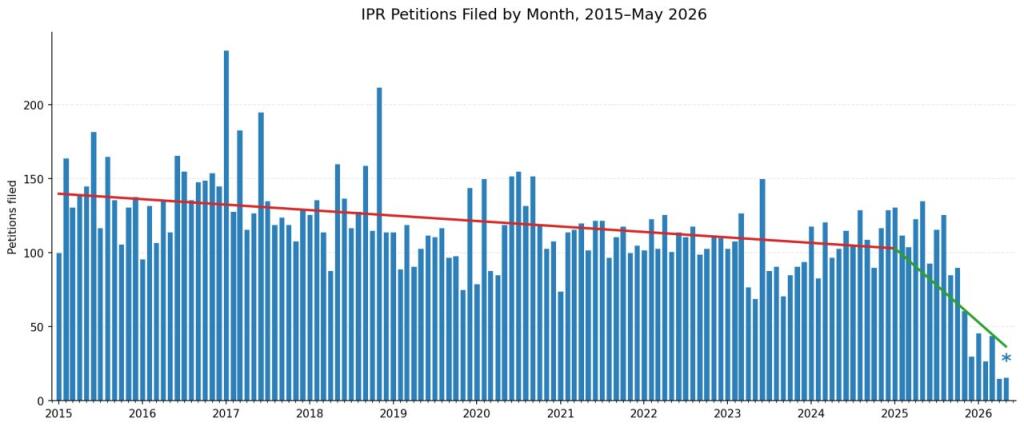
The Federal Circuit’s Inter Partes Review (IPR) system, once hailed as a streamlined, cost-effective alternative to drawn-out district court battles for invalidating patents, has seen its petition filings fall off a cliff. We’re not talking about a minor dip; the numbers for 2026 are the lowest since the America Invents Act (AIA) post-grant review system became fully operational. For years, filings reliably chugged along between 100 and 185 petitions per month. Then, starting in 2025, it was like someone pulled the plug.
This isn’t just a data anomaly. It’s a market correction, a direct response to a fundamental architectural change within the USPTO. The story of 2025 was Director Kathi Vidal’s absolute control over institution decisions, with petitions being denied at a rate so close to zero it was effectively the same. Now, in 2026, the market is speaking. Practitioners, those on the front lines calculating cost-benefit analyses for their clients, have done the math. If the merit of a challenge becomes irrelevant because petitions are being summarily punted on procedural grounds before any substantive review, the entire economic premise of the IPR dissolves.
The Unraveling of a System
The IPR was designed as a scalpel, offering a quicker, cheaper way to excise weak patents than the broadsword of district court litigation. Companies like Google, Cisco, and Intel — heavy users of the IPR system — relied on it to clear the decks of what they considered frivolous patent claims, particularly from non-practicing entities (NPEs). The appeal was undeniable: a faster timeline, a lower estoppel bar than district court trials, and a generally more favorable institution rate, at least until recently. It offered a fighting chance for defendants to strike down problematic patents before facing potentially ruinous damages in a full trial. Now, that fighting chance seems to have evaporated.
When the institution rate — the percentage of petitions the Patent Trial and Appeal Board (PTAB) agrees to hear — started to tank, the calculus shifted. Suddenly, the upfront investment in drafting and filing an IPR petition wasn’t just a calculated risk; it was a near-certain loss, regardless of the strength of the underlying prior art or legal arguments. Why pay hundreds of thousands of dollars for a process that, by design, is now engineered to reject your application at the gate?
Practitioners have done the math: if IPR petitions are denied at the front end regardless of merit, the cost-benefit calculus no longer works.
The implications are seismic. For patent holders, this might seem like a reprieve, a shield against challenges they once dreaded. But it also means that the patents that do survive this new gauntlet are likely to be incredibly strong, or held by entities with the deep pockets to defend them in district court. For patent challengers, the options narrow dramatically. District court litigation, with its longer timelines, higher costs, and more severe estoppel provisions, becomes the default. This isn’t just an inconvenience; it’s a fundamental reshaping of patent strategy, potentially pushing innovation itself into a more cautious, less dynamic posture.
Is the Market Just Adapting?
One perspective is that this is merely the market finding its equilibrium. If the USPTO is going to be an inhospitable venue for IPR petitions, then sophisticated legal players will simply reallocate their resources. They’ll shift their focus back to district court, perhaps finding ways to streamline those proceedings or to use other existing legal mechanisms more effectively. It’s possible that the IPR was simply too good a tool, and its perceived overuse or abuse by certain players prompted the current administration to rein it in. The argument could be made that the current situation, while disruptive, is simply the pendulum swinging back towards a more traditional — if less efficient — system.
But that feels like an incomplete picture. This isn’t just a minor recalibration. The near-zero institution rates, particularly under Director Vidal’s direct oversight, suggest a deliberate policy shift. It’s a message: “We are not going to be the primary venue for patent validity challenges.” Whether this is a response to genuine concerns about the IPR system’s impact on innovation or a subtle but potent pro-patent holder stance, the result is the same. The IPR system, at least in its intended form as a cost-effective bulwark against questionable patents, is functionally suspended.
This creates a vacuum. And vacuums in legal and technological landscapes tend to get filled, often with less predictable, more expensive, or even more aggressive methods. We might see an increase in demand for pre-filing invalidity opinions, or a surge in strategic licensing negotiations driven by the sheer difficulty of challenging patents. Or perhaps, and this is where things get truly interesting, a new legal or quasi-legal framework will emerge to fill the void left by the IPR’s quiet collapse.
What Happens Now?
The most immediate consequence is a significant increase in the volume and potentially the complexity of patent litigation in U.S. district courts. Companies that relied on the IPR as a first line of defense will have to recalibrate their entire litigation strategy. This means more resources poured into district court pleadings, more discovery, and ultimately, longer and more expensive trials. It’s a win for the law firms that handle these cases, but a potential setback for the speed and efficiency of innovation that patent reform aimed to foster.
Furthermore, the high bar for institution means that only the most compelling, well-prepared cases are likely to proceed. This could, paradoxically, lead to a higher win rate for those who do manage to get their petitions instituted, as they’ll likely have exceptionally strong evidence. But for the average challenge, the path is now significantly more arduous.
The functional suspension of the IPR system isn’t just a regulatory blip. It represents a fundamental rebalancing of power within the patent ecosystem. Whether this ultimately benefits innovation or stifles it remains to be seen, but the data from 2026 paints a stark picture: the era of the easily accessible, efficient IPR challenge appears to be over.