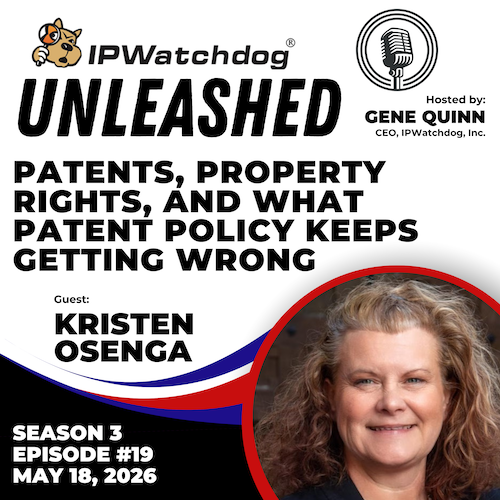
Here’s the thing: For years, the patent world has been waiting for a clear-eyed, data-driven recalibration of how we think about intellectual property. The assumption, deeply embedded in much of the scholarship and policy discussion, is that patents are an impediment, a thorny thicket that needs constant pruning to let innovation blossom. We heard it again this week on IPWatchdog Unleashed, but this time with a refreshing dose of pushback. The conversation with Professor Kristen Osenga of the University of Richmond School of Law wasn’t just another academic debate; it was a direct challenge to the prevailing orthodoxy, urging us to look at the empirical reality rather than the ideological framing.
What was everyone expecting? Likely more of the same: a recitation of established criticisms against patent owners, a call for more restrictions, and a general framing of patents as a necessary evil at best. What we got instead was a compelling argument that the entire debate is fundamentally flawed because it’s detached from how innovation actually works and how property rights are actually used in the real world.
The Disconnect: Theory vs. The Bottom Line
Osenga, a rare academic who is explicitly pro-property rights and pro-patent, brings a background that’s increasingly absent from these high-minded policy discussions. She started not in law, but in engineering – even aiming to build prosthetic legs before pivoting to electrical engineering. This isn’t just a biographical footnote; it’s foundational. Her subsequent career path, from practicing at a top IP firm like Finnegan to clerking for the Federal Circuit, provided a firsthand understanding of the stakes. As she puts it, her practical experience gave her “a real respect for patent owners.”
That respect, grounded in dealing with inventors, startups, and established companies, is precisely what’s missing from much of the patent policy discourse. Too often, academics — who may have never directly advised a patent owner or experienced the risk of investing in R&D — approach patents as an abstract problem. They analyze doctrine without deeply considering its market implications. This gap between abstract theory and the messy, risk-laden reality of commercializing new technologies has, as Osenga and the interviewer point out, done considerable damage to patent enforcement over the past 15 years.
Challenging the “Patent Troll” Scapegoat
One of the most persistent narratives Osenga’s work dismantles is the simplistic “patent troll” framing. For too long, policy discussions have been dominated by the idea that patent trolls are inherently bad actors who sue operating companies, and therefore, patent rights must be curtailed. It’s a narrative that has driven much of the legislative and judicial action against patent holders. But the reality, Osenga highlights, is far more complex. Patent litigation involves a spectrum of players: large corporations squaring off against each other, small companies fighting for survival against giants, universities commercializing research, and non-practicing entities with diverse business models, not all of whom are predatory.
The core of Osenga’s argument—and where she offers a unique insight—is that the policy response has consistently targeted the status of the patent owner (e.g., whether they manufacture) rather than their conduct. This is a critical distinction. A university, for instance, doesn’t manufacture physical products, yet its inventions are its primary asset and licensing is its pathway to market. Likewise, an individual inventor or a bootstrapped startup might possess groundbreaking technology but lack the capital, manufacturing capacity, or distribution network to bring it to market themselves. Their “product” is the invention, and their business model may rely on licensing. Labeling such entities as illegitimate simply because they don’t operate a factory is a profound misunderstanding of innovation itself. It’s akin to criticizing a novelist for not personally binding their own books.
“Your litigation behavior, not the fact you make nothing.”
This single sentence from Osenga cuts to the heart of the issue. It’s not about whether you produce widgets; it’s about whether you pursue your rights aggressively and unfairly. The focus should be on abusive tactics—like mass demand-letter campaigns or settlements based on weak patents—not on the business model of the patent holder. This is the crucial nuance lost in the broad-brush attacks on so-called patent trolls.
The Real Damage: What’s Being Missed
The damage from this skewed perspective is tangible. When policy is built on flawed assumptions, it leads to weaker patent protections. This, in turn, can disincentivize the very risk-taking and investment that patents are designed to encourage. Companies hesitate to invest billions in R&D if they can’t be confident in their ability to protect their discoveries. Startups, vital engines of innovation, may struggle to secure funding if their intellectual property is perceived as easily replicable or difficult to enforce.
Osenga’s scholarship serves as a vital corrective. By examining the actual landscape of patent litigation and the diverse strategies of patent owners, she is trying to fill the empirical void that has plagued patent policy for years. It’s a call for a more nuanced, evidence-based approach that acknowledges patents as a fundamental form of property, essential for incentivizing disclosure and investment in new technologies.
Why Does This Shift Matter for the Legal Tech Landscape?
This isn’t just an academic squabble. The way patents are treated has direct implications for the legal tech industry. Companies developing AI tools, diagnostic software, or advanced manufacturing processes all rely on a strong patent system to protect their innovations. If that system is eroded by policies based on outdated or simplistic narratives, it could stifle the development and adoption of new legal technologies. Furthermore, the very entities developing and licensing these technologies might themselves become targets of policy designed to constrain perceived abuses, even if their conduct is entirely legitimate. We’re not just talking about protecting inventors; we’re talking about the future of technological advancement itself, and by extension, the tools that will power the legal profession in the years to come.
Key Takeaways:
- The patent policy debate is often detached from the empirical reality of innovation and commercialization.
- Focusing on the conduct of patent litigation, not the status of the patent owner, is essential for effective reform.
- Nuance is lost in the simplistic “patent troll” narrative, harming legitimate innovators and investors.
- A strong property rights framework is crucial for incentivizing R&D and technological advancement.
**
🧬 Related Insights
- Read more: Alito’s Sudden Hospital Dash: A Wake-Up Call for AI’s Supreme Court Battles
- Read more: Trade Secret Law: Unjust Enrichment Now a Plaintiff’s Secret Weapon
Frequently Asked Questions**
-
What does Kristen Osenga argue about patent trolls? Osenga argues that policy debates have wrongly focused on whether a patent owner manufactures products, rather than examining their actual litigation behavior. She believes policy should target abusive conduct, not the business model of the patent holder.
-
Why is the practical experience of patent lawyers important for policy? Practical experience provides a real-world understanding of how patent decisions affect inventors, investors, and companies. This grounding is often missing in academic policy discussions, leading to theoretical approaches that don’t align with marketplace realities.
-
How does this affect innovation? When patent policy is based on flawed assumptions, it can weaken patent protections. This, in turn, may disincentivize the R&D investment and risk-taking that patents are designed to encourage, potentially slowing down technological advancement.