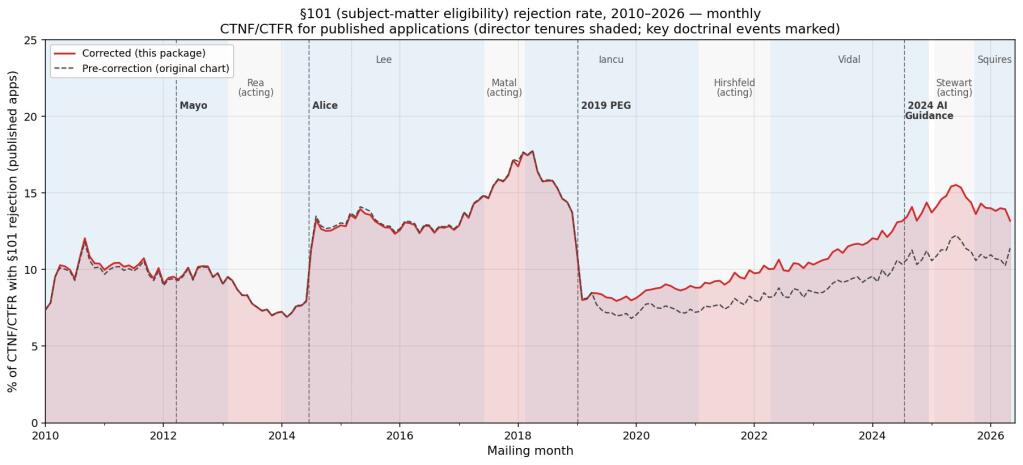
So, what does this mean for the poor sod trying to get a patent? It means the paperwork is probably still a bureaucratic nightmare, just with slightly different statistical peaks and valleys. Dennis Crouch at Patently-O thought he had the patent eligibility rejection rates figured out. Sixteen years of data. A clear picture. Nope.
Turns out, some of the longest office actions – the ones that likely contain the most convoluted legal arguments – were getting silently botched by optical character recognition. And a chunk of the USPTO’s bulk data? It just vanished. Poof. Gone. Reconstructed using the API, because apparently, consistency is a foreign concept at the USPTO. This isn’t just a minor hiccup; it’s a fresh reminder that the data we rely on to understand patent law is often as reliable as a politician’s promise.
The Post-2019 Rollercoaster Just Got Longer
What’s the big deal? The corrected chart shows that the post-2019 surge in rejections was actually bigger than first reported. We’re talking a jump back up to around 15.5% by mid-2025. That’s practically vintage 101 chaos, inching back towards those pre-patent-examination-guideline (PEG) peaks. The recent dip, attributed to the Stewart and Squires tenures? It’s there, sure, but it’s a footnote compared to the seismic shift upwards.
This isn’t just about numbers on a chart. It’s about real people, real inventions, and real money spent on applications that are subject to the whims of an opaque system. Imagine spending years and a small fortune on R&D, only to have your patent eligibility tossed aside based on data that was… well, wrong. It’s enough to make you want to patent a time machine just to go back and file earlier.
“The corrected chart does not disturb the central thesis, but it does provide additional insight.”
Additional insight? Try a panicked scramble to re-evaluate everything. The ‘central thesis’ that examiner behavior tracks administrative policy more than Supreme Court doctrine might still hold, but now it’s based on a foundation that was, shall we say, slightly shaky. It’s like building a house on a foundation of Jell-O.
Is This Just Tech Bro Whining?
Some might dismiss this as technical nitpicking. “It’s just data, what does it matter to the average person?” Well, it matters because Section 101 is the gatekeeper for software patents. If you’re developing new algorithms, AI models, or any kind of technological innovation that can be expressed in code, 101 is your personal Everest. A high rejection rate means a higher barrier to entry, stifling innovation and potentially giving larger, established players an advantage because they can absorb the costs and uncertainty.
This data correction highlights a deeper, systemic problem: the USPTO’s own data infrastructure seems to be struggling with the complexity and volume of patent applications. If the agency can’t accurately track its own rejection rates, how can we trust its pronouncements on patent policy? It’s a bit like a chef losing the recipe for their signature dish and then trying to tell you how good it tastes.
And let’s not forget the timing. This correction comes after a period where the USPTO has been under pressure to clarify and stabilize its stance on patent eligibility. These swings in data, even after correction, suggest that the promised stability is still a distant dream. It’s the sort of thing that makes you question the very foundations of patent law. Are we trying to apply rigid rules to inherently fluid technological advancements? It’s a perennial question, and this data doesn’t exactly offer a soothing answer.
This whole affair smacks of corporate PR trying to spin a narrative. “Don’t worry, it’s just a small data correction, our core message remains intact!” But the devil, as always, is in the details. And here, the details are messy. They suggest that the path to understanding patent eligibility is anything but clear, and the USPTO’s own data is a proof to that confusion.
**
🧬 Related Insights
- Read more: Florida Takes AI Harm Seriously: A Governor’s Bold Move
- Read more: Your Boss’s Spyware is Feeding Meta and Google Data
Frequently Asked Questions**
What is Section 101 in US patent law? Section 101 defines what is eligible for patent protection, covering inventions that are processes, machines, manufactures, or compositions of matter. It has become a major battleground for software and business method patents.
Will this affect my software patent application? Potentially. The volatility in §101 rejection rates suggests that the criteria for patent eligibility can shift, making it harder to predict outcomes for software and AI inventions.
Where can I find the corrected data? The corrected data, as analyzed by Dennis Crouch, is available on the Patently-O website, though access to the full analysis may require membership.