Patent law’s biggest worry.
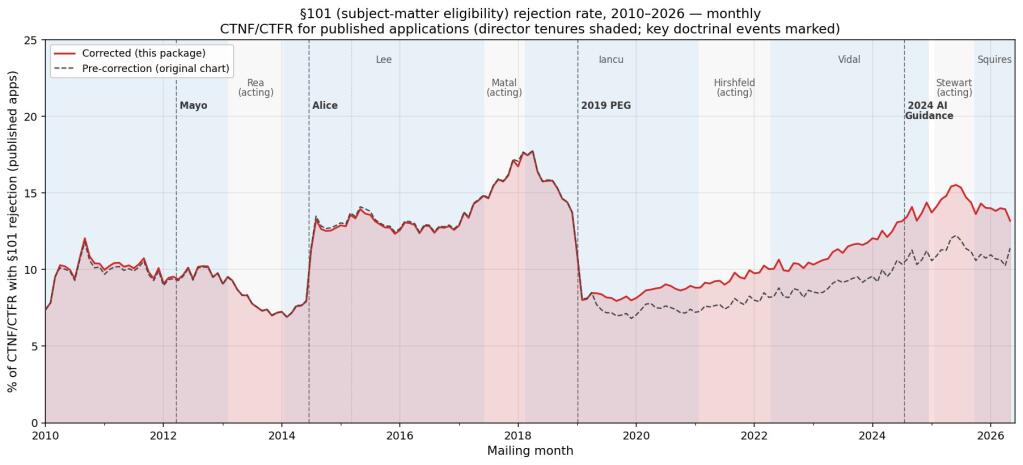
Look, it’s been a weird few years for patent law, especially when it comes to that ever-expanding black hole known as Section 101. Remember Alice Corp. v. CLS Bank International? Yeah, that was way back in 2014, and ever since, the Supreme Court has been doing its best impression of a teenager avoiding chores by punting on patent eligibility questions. It’s like they want the Federal Circuit to keep making it up as they go. And guess what? With about a month left in their current term, a few more of these doozies are still sitting there, collecting dust, waiting for a decision that could either bring some semblance of order or just throw more kerosene on the fire.
Here’s the thing: the Supreme Court’s term is almost over, and while some patent cases have been swiftly shown the door, a couple of real head-scratchers are still lingering. It’s these lingering cases, particularly those wrestling with the ever-pesky Section 101 patent eligibility rules that the Alice decision made so… complicated, that we’re really watching. This stuff matters because, frankly, if you can’t get a clear picture of what’s patentable, especially in tech, then what are we even doing here? Lawyers are making a mint arguing about it, but actual inventors? They’re probably just pulling their hair out.
Cisco Systems v. SRI International: Enhanced Damages Get the Boot (Sort Of)
So, Cisco Systems wanted the Supreme Court to weigh in on whether you can get those juicy enhanced damages for patent infringement without proving some truly heinous, over-the-top behavior. The Federal Circuit had already dialed back a previous decision, saying the Halo Electronics standard for “wanton, malicious, and bad-faith behavior” was really just about the level of enhanced damages, not whether you get them at all. Cisco, naturally, thought this was a good time to ask the High Court to clarify things.
The Federal Circuit’s Cisco decision clarified that the language from Halo Electronics v. Pulse Electronics (2016) on “wanton, malicious, and bad-faith behavior” only applied to enhanced damages determinations, not findings of willful infringement.
Well, surprise, surprise. The Supreme Court yawned and denied Cisco’s petition. This means the Federal Circuit’s interpretation of Halo is, for now, the law of the land. So, while the question of just how bad you have to be to get those extra damages might still be fuzzy, at least the principle that the Halo standard applies to the amount of damages, not the finding of willfulness, is settled. For Cisco, this probably means a lot of legal wrangling continues, and for patent holders, it’s a small win that doesn’t really change the underlying complexity. It’s like saying “we’ll get to it later” to a leaky faucet.
PersonalWeb Technologies v. Patreon: Preclusion, Kessler, and More Preclusion
Then we’ve got PersonalWeb Technologies v. Patreon. This one’s a bit of a procedural mess, involving something called patent-specific preclusion. Basically, PersonalWeb got hit with a previous ruling that essentially said their patent claims were a no-go. The Federal Circuit, citing an old Supreme Court case called Kessler v. Eldred (from 1907, which tells you something about how stale some of this patent law is), said that even if standard claim and issue preclusion don’t apply, there’s this other preclusion thingy that stops you. The kicker here? The prior ruling that stopped PersonalWeb wasn’t a full-blown trial verdict of non-infringement, but a settlement with a stipulated dismissal. PersonalWeb’s argument? That Kessler shouldn’t apply when the prior case just got dropped, not decided on its merits.
This whole dance got a little more interesting when the U.S. Solicitor General weighed in. They basically admitted the Federal Circuit might have messed up the Kessler doctrine’s application. However, they argued against the Supreme Court taking the case because, really, the Federal Circuit’s ruling could still be justified using the regular old claim and issue preclusion rules. So, the government agrees something’s fishy with Kessler, but thinks the outcome was still okay. PersonalWeb fired back, saying, “Hold on, the Kessler issue is the issue, and you can’t just sweep it under the rug because other rules might apply.”
And guess what happened? Cert denied. Again. It seems the Supreme Court isn’t interested in untangling the nuances of historical patent preclusion doctrines, even when the government concedes an error. This leaves the Federal Circuit’s interpretation of Kessler and its application to settled cases largely intact, creating a potential minefield for patent litigants who might find themselves barred from bringing claims for reasons that feel, shall we say, a bit arbitrary. Who’s making money here? Lawyers arguing about preclusion, that’s who.
American Axle v. Neapco: The Big One Still Waiting
Now, this is the one that’s been making waves. American Axle & Manufacturing v. Neapco Holdings. The quoted line at the top? That’s not hyperbole. This case is seen by many as the next big showdown over Section 101, the same section that’s been “slowly swallowing all of patent law” since Alice. The concern is that the Federal Circuit’s interpretation could expand the definition of an “abstract idea” to the point where almost anything that involves a process or a calculation could be deemed unpatentable. Think about that for a second. In a world driven by software, AI, and complex diagnostics, what doesn’t involve a process or a calculation?
“[F]ew [petitions for cert] have garnered as much interest as American Axle & Manufacturing v. Neapco Holdings as it represents a major expansion to the Section 101 abstract idea jurisprudence that has been slowly swallowing all of patent law since the Supreme Court handed down Alice Corp. v. CLS Bank International back in 2014.”
This case has been a slow burn. The Supreme Court has been waiting for the Solicitor General’s opinion on whether to take the case for a year. A whole year. That’s an eternity in legal time. When the SG’s brief finally dropped, it was… anticlimactic. It argued that the Supreme Court shouldn’t grant cert. The reasoning? The Federal Circuit’s decision, while maybe not perfectly articulated, was essentially correct and didn’t represent a significant enough departure to warrant Supreme Court review. This feels like another punt, but one with potentially massive implications. If the Supreme Court ultimately decides not to hear American Axle, the Federal Circuit’s interpretation of Section 101, which many fear is far too restrictive, will continue to be the rule. This will make it even harder for inventors and companies to obtain and enforce patents on their innovations, particularly in technology sectors that rely heavily on inventive processes and software.
So, what does this all mean? It means that despite the Supreme Court’s best efforts to avoid it, the messy, unpredictable world of patent eligibility under Section 101 is likely to persist. The lack of clear guidance from the High Court continues to create uncertainty, stifle innovation, and keep patent lawyers very, very busy. The big question remains: when will the Supreme Court finally step in and offer some much-needed clarity, or are they content to let the Federal Circuit continue its slow, steady dismantling of what was once a strong patent system?
Why Does This Matter for Inventors?
Look, you might be an inventor, a startup founder, or a business owner. You’ve poured your heart, soul, and probably a ton of cash into creating something new. You file a patent, thinking you’ve secured your intellectual property. But then, some slick corporate lawyer pulls out the Section 101 argument, claiming your invention is just an “abstract idea” or a “law of nature” and therefore not patentable. Suddenly, that valuable patent you thought you had is worthless. This is the reality driven by the ongoing Section 101 chaos. The Supreme Court’s reluctance to definitively address these issues means that the patentability of many modern inventions – particularly those in software, business methods, and diagnostic tools – remains perpetually in doubt. It’s not just about legal theories; it’s about whether your hard work and innovation will ever be protected, allowing you to actually profit from it. And right now, the odds are increasingly stacked against that.
🧬 Related Insights
- Read more: EU Member States’ Crushing Load: 88 AI Act Tasks That Could Fracture Enforcement
- Read more: OpenAI’s Bold Bet: Shielding Itself from AI Apocalypse Liability in Illinois
Frequently Asked Questions
What is Section 101 patent eligibility jurisprudence?
Section 101 of the U.S. patent code defines what subject matter is eligible for a patent. Jurisprudence refers to the body of court decisions that interpret these laws. In recent years, particularly after the Supreme Court’s Alice decision, Section 101 jurisprudence has become a major hurdle for patent eligibility, especially for software and business method patents, often being used to invalidate patents deemed to be based on “abstract ideas.”
Will the Supreme Court’s decisions this term change patent law significantly?
The Supreme Court has denied cert in several patent cases this term, meaning their lower court decisions stand. However, the pending American Axle v. Neapco case could still have a significant impact on Section 101 jurisprudence if the Court decides to hear it. Its denial of cert in other cases suggests a continued reluctance to broadly address patent law issues.
What does it mean when the Supreme Court denies a petition for writ of certiorari?
Denying a petition for writ of certiorari means the Supreme Court has chosen not to hear the case. The decision of the lower court (usually the Federal Circuit in patent cases) remains in effect. It does not mean the Supreme Court agrees with the lower court’s decision, but rather that they do not believe the case presents a question of federal law that warrants their review at that time.