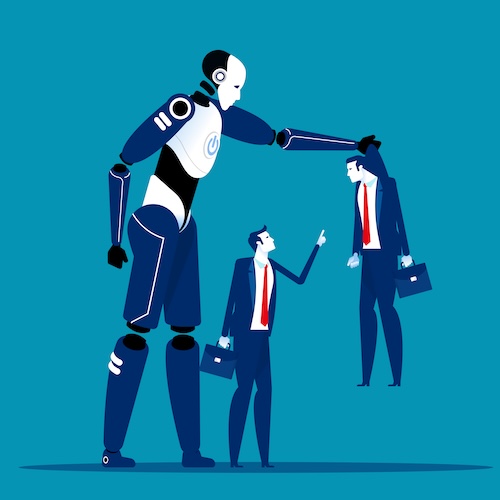
The hum of servers, not the chatter of paralegals, now often signals the cutting edge of invention disclosure.
For decades, patent law firms operated on a bedrock principle: specialized knowledge, intense labor, and procedural labyrinth meant companies needed outside help. Firms provided the infrastructure—the expertise, the staff, the docket systems. Clients supplied the raw ideas and the budget. This division of labor, while perhaps not always elegant or efficient, was a stable ecosystem. Now, it’s fraying.
In-house patent teams are doing more than just reconsidering work allocation; they’re questioning the very necessity of external engagement. The question isn’t just if work can be done more efficiently, but if it needs to be done by outsiders at all. AI is the catalyst, and while it’s not making everything simply faster or cheaper, it’s certainly creating new friction. Take initial invention disclosures—clients are deploying AI before establishing internal guardrails, leading to a murky handover of AI-generated output to law firms. The fundamental challenge for these firms is clear: define and defend the value proposition that AI and internal client resources cannot consistently replicate.
What’s Truly Indispensable for Law Firms?
Some areas of patent law will undoubtedly remain the exclusive domain of skilled practitioners. However, the ground is shifting, and much of the traditional work is becoming vulnerable to internalization. Drafting, routine prosecution, and preliminary searches are fast becoming commoditized. Clients are understandably pushing back against premium rates for tasks they believe technology can now largely handle. Firms clinging to the ‘every task is bespoke attorney labor’ model will encounter significant resistance.
This isn’t to say clients always grasp the nuances. Many independent inventors, and even some corporate clients desperate for cost savings, often underestimate the complexity. They might send a sprawling, rambling 40-page disclosure and expect a patent attorney to make it ‘file-ready’ in an hour. As any seasoned practitioner knows, deciphering such documents, let alone identifying prior art, requires orders of magnitude more time than a superficial review.
Ironically, this mirrors the current corporate client mindset driven by the perceived efficiency of AI. They’re beginning to sound like that overly optimistic independent inventor.
Every patent professional understands the perils: a seemingly minor amendment can create prosecution history estoppel, a subtle wording change can drastically narrow claim scope, and a mischaracterization of prior art can doom enforcement years down the line. Yet, as the end-to-end patent process appears commoditized, and the role of AI is often exaggerated, unrealistic expectations are becoming the norm.
The AI Efficiency Mirage
Here’s the insidious part: clients’ adoption of AI is breeding an “illusion of efficiency.” Historically, outside counsel often battled insufficient information from inventors and internal teams. Disclosures were frequently incomplete, conclusory, or lacked critical technical details. Now, with AI generating something, clients may believe they’ve sufficiently de-risked the initial input, overlooking the qualitative gaps that still require expert human intervention.
This dynamic forces a reckoning. Patent firms can no longer rely on inertia or historical client practices. They must articulate—with pinpoint accuracy—where their deep expertise adds irreplaceable value. This means understanding that commoditized tasks, those readily handled by AI or in-house teams with new tools, need to be either jettisoned, redefined, or priced accordingly.
The market is signaling a clear shift: clients want external counsel for strategic insights and complex problem-solving, not for process-driven execution that AI can approximate. The firms that embrace this reality, focusing on high-value intellectual property strategy, complex patent litigation, and specialized advisory services, will likely thrive. Those that don’t? They risk becoming footnotes in the history of legal service evolution.
As one firm partner, speaking off the record about the pressures, put it: “We used to be the gatekeepers of information and process. Now, clients are building their own gates with AI, and they’re only calling us to help them through the trickiest locks, not to open the whole door.”
This isn’t just about efficiency; it’s about value. AI isn’t replacing patent attorneys wholesale, but it’s certainly exposing the less defensible aspects of the traditional law firm business model. Firms must evolve, demonstrating how their judgment, experience, and strategic thinking — elements AI currently cannot replicate — translate into tangible client advantage.
Why Does This Matter for Law Firms?
It matters because the economics are undeniable. Clients internalizing work means reduced billable hours for outside counsel. It means pressure on fee structures, forcing a move away from pure time-and-materials billing toward more value-based or fixed-fee arrangements. For firms that have become accustomed to high margins on high-volume, lower-complexity work, this represents an existential challenge.
Moreover, the client’s ability to generate initial disclosures via AI means they are now more informed—or at least feel more informed—about the patent process. This changes the negotiation dynamic. Clients are likely to be more critical of the advice they receive and more demanding of transparency and demonstrable ROI. The era of ‘because we said so’ in patent strategy is rapidly drawing to a close.
The true litmus test for patent law firms will be their agility in adapting their service offerings. This could involve developing AI-powered tools of their own to augment their attorneys, creating specialized consulting arms, or doubling down on areas where human expertise remains paramount—like navigating complex international patent landscapes or defending against high-stakes infringement suits. The firms that can pivot, offering integrated solutions that combine technological prowess with profound legal acumen, will not only survive but potentially redefine their market position.
🧬 Related Insights
- Read more: Axiom Unlocks Harvey AI for 14,000 On-Demand Lawyers—and Their Clients
- Read more: Pro Codes Act Rises Again: Copyright Clash Over the Blueprints of Safety
Frequently Asked Questions
What does AI do for patent disclosures? AI can assist in drafting initial invention disclosures by processing technical information, suggesting potential claims, and identifying relevant prior art. However, it often requires significant human review and refinement to ensure accuracy, completeness, and strategic alignment.
Will AI replace patent attorneys? AI is unlikely to replace patent attorneys entirely. It excels at automating repetitive tasks and processing data, but it lacks the nuanced judgment, strategic thinking, and complex problem-solving skills essential for high-stakes patent prosecution, litigation, and strategic IP counseling.
How are clients changing their approach to patent work? Clients are increasingly using AI to internalize patent work, leading to greater demand for predictable pricing, a shift in work allocation from outside counsel to in-house teams, and a focus on firms that can demonstrate unique value beyond commoditized tasks.