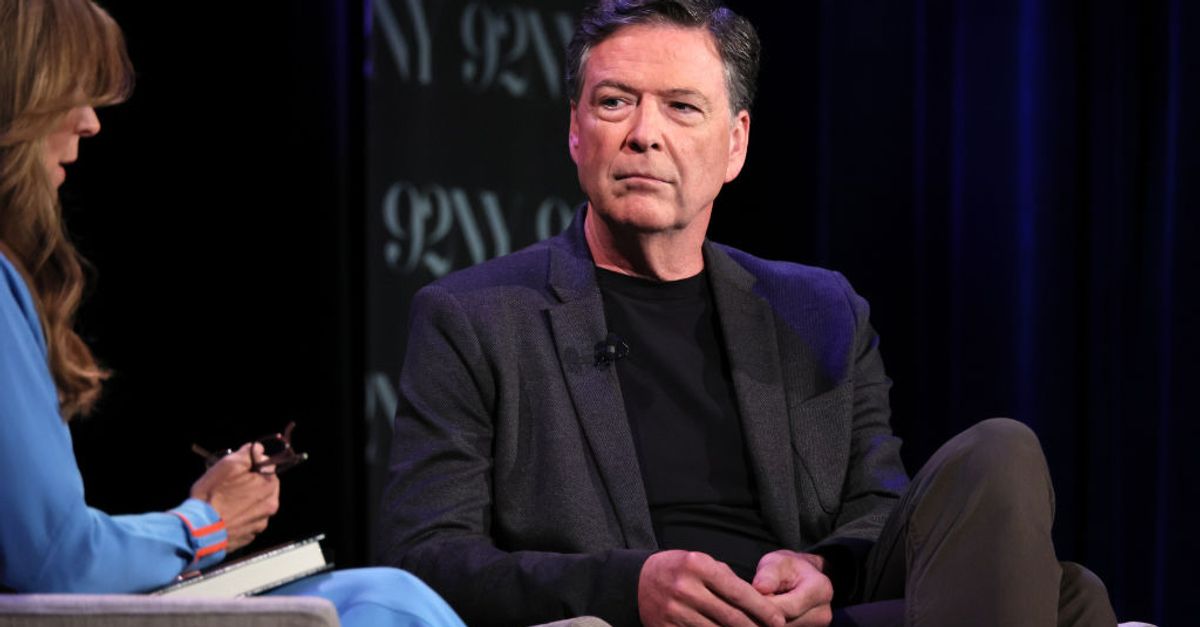
So, James Comey, former FBI honcho, gets indicted. For what? Apparently, for posting a picture of seashells on a beach that spelled out ‘86 47’. Yes, really. The Department of Justice, bless their hearts, is claiming this cryptic beach photo constitutes a threat against President Trump, invoking mob lingo supposedly meaning ‘kill him.’ It’s the kind of story that makes you wonder if the legal system has entirely lost its mind or if someone in the D.C. cafeteria ran out of real news. But peel back the layers of absurdity, and you’re left with a surprisingly thorny legal question: what exactly constitutes a ‘true threat’ under the First Amendment?
The indictment, if you can call it that, leans on two federal statutes: 18 U.S.C. § 871, for threatening the President, and 18 U.S.C. § 875, for interstate threats. The alleged ‘threat’? The image, posted in May 2025, interpreted by Trump and subsequently the DOJ as ‘kill President Trump.’ This whole affair reeks of political theater, a spectacle designed to land with a thud rather than spark genuine legal debate. It’s a PR stunt masquerading as jurisprudence.
The Ghost of Robert Watts Past
This isn’t the first time the courts have wrestled with whether angry words, political rants, or even oddly specific social media posts cross the line from protected speech into something more sinister. The bedrock case here, for anyone actually keeping score, is Watts v. United States from 1969. Back then, a fellow named Robert Watts, at an anti-war rally, muttered that if drafted, the first person he’d get in his sights was President Lyndon B. Johnson. A crude, offensive statement, sure. But the Supreme Court, bless its historically messy soul, saw it differently. They ruled it was ‘political hyperbole,’ ‘crude offensive method of stating a political opposition,’ not a genuine threat of violence. The context, the conditional nature of the statement, even the laughter that followed – it all mattered. Sound familiar?
This distinction is the razor’s edge the Comey indictment now teeters upon. The government has to prove that Comey’s seashell symphony was a ‘true threat,’ a category of speech that, thankfully, doesn’t get the same cushy First Amendment protections. But proving intent, especially when the alleged ‘intent’ is being retroactively supplied by the target of the supposed threat, is a legal minefield. Who decides what’s ‘reasonably interpreted’ by someone ‘familiar with the circumstances’? When those circumstances are manufactured by a social media platform designed for outrage and a former President who thrives on it?
When Speech Becomes a ‘Serious Expression’
The Supreme Court revisited this thorny issue in Virginia v. Black (2003), clarifying that a true threat is one where ‘the speaker means to communicate a serious expression of an intent to commit an act of unlawful violence.’ Crucially, the speaker doesn’t have to actually intend to carry it out, but they must intend to ‘plac[e] the victim in fear of bodily harm or death.’ This is where the Comey case gets particularly sticky. Did Comey intend to put Trump in fear? Or did he intend to… what? Make a statement about the number 86? Express some obscure political sentiment? The indictment’s vagueness is its most damning feature.
And let’s not forget Elonis v. United States (2015), which really dug into the intent required for a threat under statutes like the one Comey is charged under. The question there was whether the prosecution needed to prove the defendant personally intended to threaten someone. The court sidestepped a definitive answer on the objective standard vs. subjective intent, remanding the case. It’s a legal gray area, precisely the kind of territory prosecutors might try to exploit when the evidence is, well, seashells.
Here’s the thing that most of these legal explainers shy away from: The real question isn’t just about legal precedent. It’s about who holds the power and who benefits. This indictment, whether it sticks or implodes under scrutiny, serves a purpose. For the DOJ, it’s a way to signal something—perhaps loyalty, perhaps a desire to appear tough on perceived enemies. For Trump, it’s another opportunity to frame himself as a victim of politically motivated persecution, a narrative he’s cultivated with alarming success. My money is on this being less about constitutional law and more about political maneuvering, using the courts as a stage. The First Amendment, it seems, is increasingly becoming just another battleground for the culture wars, and ‘true threats’ are merely the latest ammunition.
Is this whole kerfuffle going to end up anywhere? Probably not. These kinds of politically charged indictments, especially when they hinge on such flimsy interpretations, often fizzle out. The legal hurdles, particularly the First Amendment’s strong protections for even offensive speech, are substantial. But the noise, the distraction, the ability to drag a former high-ranking official through the mud – that’s the real win for some parties involved here.
The Shell Game: Intent vs. Interpretation
This entire saga boils down to a shell game of intent and interpretation. The prosecution has to bridge the massive gap between Comey posting a picture and that picture being a true threat. They’re relying on Trump’s interpretation, which is… convenient. It’s a circular argument where the alleged victim’s interpretation becomes the evidence of the perpetrator’s intent. This isn’t how justice is supposed to work. It’s a recipe for chilling speech, not protecting against violence.
Ultimately, the Comey seashell incident is a stark reminder of how easily legal concepts can be weaponized. The First Amendment protects a vast spectrum of expression, even speech that is obnoxious, offensive, or deeply unpopular. Drawing the line at ‘true threats’ is a necessary safeguard, but it requires more than a suggestive photo and a politically motivated interpretation to cross it. This case, like so many others lately, feels less like a pursuit of justice and more like a performance.
Why Does This Matter for the First Amendment?
This case, if it ever progresses meaningfully, could have implications for how courts define and apply the ‘true threat’ doctrine. It pushes the boundaries on what constitutes intent and how much weight should be given to a recipient’s subjective interpretation, particularly when that recipient is a public figure with a known propensity for interpreting statements through a partisan lens. The danger lies in setting a precedent where any ambiguous or coded message, amplified by a polarizing figure, can be twisted into a criminal act.
Will Comey Go to Jail Over Seashells?
It’s highly unlikely. The legal bar for proving a ‘true threat’ is significant, and the First Amendment provides broad protections for speech, especially political speech. The indictment faces substantial constitutional challenges. The case is more likely to be dismissed on First Amendment grounds or quietly dropped than to result in a conviction.
What Is a ‘True Threat’ Under US Law?
A ‘true threat’ is speech that a reasonable person would foresee as communicating a serious expression of an intent to commit an act of unlawful violence. It’s not mere political hyperbole or offensive speech; it requires intent to communicate a threat of violence and often, an intent to place the recipient in fear. The Supreme Court has grappled with the exact definition, particularly regarding the speaker’s subjective intent versus an objective standard of what a reasonable person would perceive.