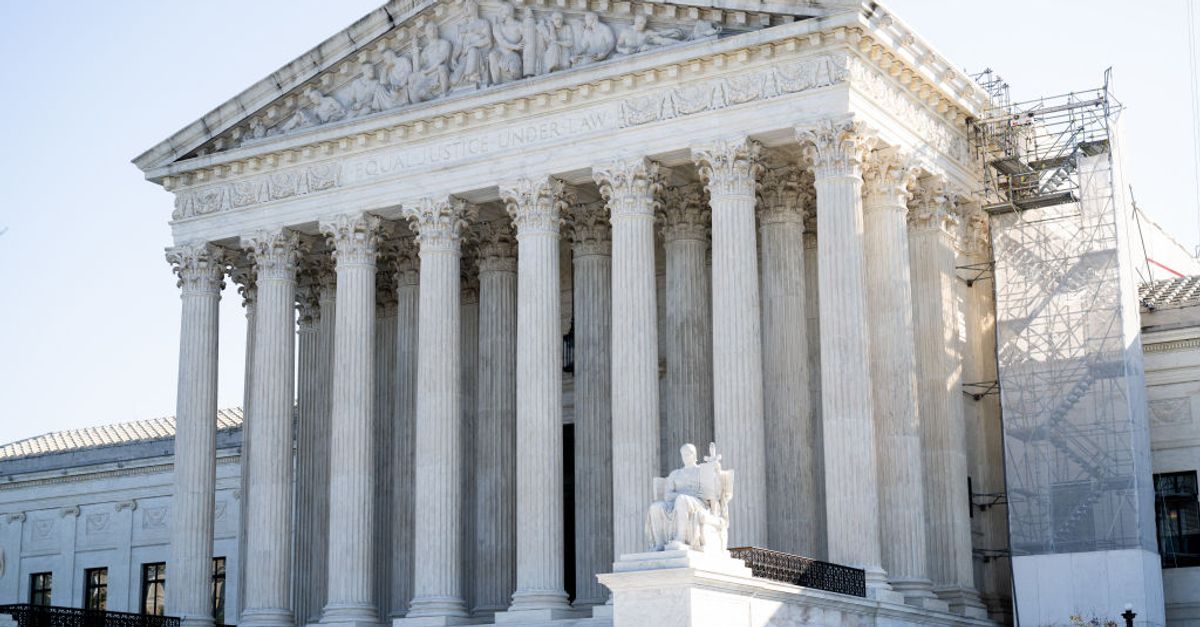
Could the Supreme Court become the ultimate arbiter of what medications arrive at your doorstep?
That’s the simmering question beneath Louisiana’s urgent plea to the highest court, a battleground where the mail-order abortion pill, mifepristone, is the latest casualty. The state isn’t just asking to keep a lower court’s order in place; it’s trying to establish a precedent that could fundamentally alter how federal health regulations interact with state-imposed restrictions, especially in the deeply contentious arena of reproductive rights.
At its core, this is about standing – who has the right to sue, and on what grounds. Louisiana, joined by drug manufacturers Danco Laboratories and GenBioPro, are locked in a legal tug-of-war over whether the state can claim injury from the FDA’s decision to allow mifepristone to be mailed. Louisiana’s argument, as laid out in its 58-page filing, paints a picture of federal overreach, a deliberate move by the Biden administration to “undermine” the post-Roe landscape. They claim nearly 1,000 illegal abortions monthly are facilitated by mail-order pills, a figure that’s hard to independently verify but serves as a stark statistical weapon.
This isn’t a new skirmish. It’s a continuation of a protracted legal dance that’s seen various plaintiffs—doctors, medical groups, and now states—attempt to derail the FDA’s expanded access to mifepristone. The Supreme Court has previously punted on these challenges, notably in FDA v. Alliance for Hippocratic Medicine, where it ruled that abortion opponents lacked the standing to sue over the drug’s approval. Justice Kavanaugh was clear: sincere objections, while noted, didn’t translate into a legally actionable harm.
But Louisiana’s approach feels different. It’s not just about moral or ideological opposition. The state argues that by allowing mifepristone to be remotely prescribed and mailed, the FDA has effectively “opened the door for mifepristone to be remotely prescribed to Louisiana women,” thereby interfering with Louisiana’s own restrictive abortion laws. This is where the architectural shift is truly at play: transforming a drug safety issue into a federalism battle disguised as a standing problem.
The Core of the Conflict: Standing and ‘Harm’
The crux of the matter hinges on what constitutes actionable harm. Louisiana contends that if a woman in their state obtains mifepristone via mail and experiences a complication requiring medical care, Louisiana taxpayers might have to foot the bill. This is Louisiana’s interpretation of harm – an economic burden linked to a federal policy it opposes. The mifepristone manufacturers, however, see this as a far more tenuous claim than what the Supreme Court rejected just two years ago.
Their brief to the court is sharp, arguing that Louisiana’s standing theory is “a more attenuated version” of arguments the Court has already dismissed. They contend that the state’s injury is not the kind courts are equipped to review, particularly when the FDA is still conducting its own safety reviews. The manufacturers want the years-long status quo—where mifepristone has been widely available—to persist during this ongoing regulatory process.
This legal tightrope walk has direct implications for how telehealth and mail-order pharmacies will function in the future, especially for sensitive medications. If Louisiana prevails, it could embolden other states to challenge federal drug approvals by manufacturing their own interpretations of harm, creating a patchwork of access that’s dictated by individual state legislatures rather than federal health agencies.
A Precedent in the Making?
What’s fascinating here is the potential for this case to redefine the boundaries of federal authority versus state control over healthcare. We’re seeing a deliberate effort to re-litigate access to abortion medication not through the lens of a constitutional right, but through the procedural mechanism of administrative law and judicial standing. The Fifth Circuit’s ruling, which Louisiana is desperate to uphold, found that the state does have standing. That’s the linchpin. If the Supreme Court agrees, it’s not just about this pill; it’s about the very nature of federal preemption and how states can push back.
The manufacturers’ concern is palpable. They argue that the Fifth Circuit’s view of standing is “unusually broad and novel.” This isn’t hyperbole; it’s a genuine worry that a ruling in favor of Louisiana could create an unstable legal environment for drug manufacturers nationwide.
Louisiana’s plea for the Court to take up the case now, before its summer recess, underscores the urgency they feel. They want a definitive ruling that aligns with their vision of state-driven healthcare policy, a vision that stands in stark opposition to the FDA’s more permissive stance. And if the Court does pause the Fifth Circuit’s order, Louisiana wants it to signal that the case is ripe for immediate resolution, essentially pushing for an oral argument sooner rather than later.
This isn’t just a legal filing; it’s a shot across the bow. It’s a state signaling its intent to weaponize procedural challenges to obstruct federal policy. The Supreme Court’s eventual decision will undoubtedly ripple far beyond Louisiana, shaping how medication access is regulated in an increasingly digital and geographically dispersed America.
🧬 Related Insights
- Read more: Paul Weiss Hits $4B: Biglaw’s Manhattan Miracle or Just More Billable Hours?
- Read more: USPTO’s MATTHEW AI Vows to Bury Alice Patent Nightmares—Skeptics Aren’t Buying It
Frequently Asked Questions
What is mifepristone? Mifepristone is one of two drugs used in medication abortions. It works by blocking progesterone, a hormone necessary for pregnancy to continue.
Why does Louisiana want to ban mailing mifepristone? Louisiana argues that mailing the abortion pill circumvents its state laws restricting abortion access and potentially creates health complications for which the state might bear costs.
Can the Supreme Court ban mail-order abortion pills nationwide? The Supreme Court could uphold the Fifth Circuit’s order, which would stop the mailing of mifepristone in Louisiana. A broader ruling could have nationwide implications for drug access and federal authority, but a direct nationwide ban is unlikely in this specific case without additional legislative or regulatory action. The current fight is about standing to challenge FDA regulations.